
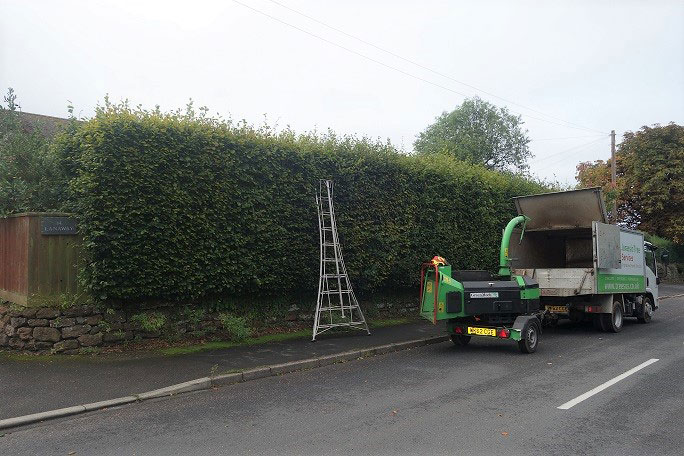
Hedges - A Crucial Habitat
'Hedges are the stitching in the patchwork quilt of the English countryside’, an English saying that certainly still rings true today. Hedges form part of the very fabric of British landscape and they have an incredibly important role as a habitat that supports a diverse range of wildlife. Hedges provide shelter to roughly 125 of our most threatened species and offer a real safe haven for wildlife.
An incredible 2070 different species can be found within an 85 metre stretch of hedgerow in Devon! Providing a habitat for threatened insect-eating birds and native bees, they also help to control dust, reduce sound pollution and prevent erosion. Around 70% of the UK consists of agricultural land and hedges form boundaries for this rich habitat structure. In residential areas, hedges are very useful to delineate property lines, block unsightly views, provide privacy screening and also act as windbreakers. So, how do you define what is a hedge and what is a hedgerow? - Hedges consist of a single plant species formed in tightly spaced rows, whilst a hedgerow is a broad planted bed that includes a variety of trees and shrubs.
Hedge Management
Do you have a hedge in your garden that is a bit scraggly and unkempt? After considering all the benefits that a hedge has to offer, perhaps it’s time to redefine how you think about it and give it some love and attention!
The first thing to look at is edge maintenance, and here it’s a case of a careful balancing act. Make too many cuts and you could end up with bare bushes, leave it untended and it can become quickly untidy and spill over boundaries. And it's not only about trimming, there’s also regular watering, feeding and pruning to be done if you want to keep a hedge looking at its best. The most difficult task when it comes to hedge maintenance is pruning and hedge removal. Before we tackle hedge removal, let us look at some of the ways you can maintain and manage your hedges :
- Hand pruning - Hand prune hedges to allow sunlight through to its centre.
- Winter pruning - Pruning in the winter helps prevent buds from breaking, diverting the plant's energy to new growth where you want it most.
- Wide base - Trim hedges so that they are wider at the base and narrower at the top. This allows lower branches to get enough sunlight.
- Maintain space - Plant hedges with enough space between them to grow sufficiently. Maintaining a diameter of 3 feet between them is standard good practice. Alternatively, you can choose a species that won't outgrow the space.
Hedge Removal
Hedge removal requires a great deal of digging to a depth that’s dictated by the size and species of your hedge. You can use a shovel, a spade, a fork and a crowbar to aid you. You may even require a mechanical digger if the job is particularly arduous. Hedge removal should be conducted right down to the roots. Disposal of the roots, leaves and twigs may be too much for a regular council waste disposal facility, and you may require specialist disposal. The area that’s left after the removal needs to be backfilled with soil.
Hedge removal is subject to protection orders, and breaking these could land you on the wrong side of the law (particularly in the case of countryside hedging). Removing protected hedges can result in a fine of up to £5000 in a magistrates court, or a potential unlimited fine from the Crown court. You should always seek expert advice if you are unsure whether the hedge you want removed is under protection. However, regulations do not apply to hedges marking the boundaries of private houses. Permission need not be sought when removing hedges less than 20m long that do not meet another hedge at either end. Hedge removal can be carried out if :
- The hedge is less than 30 years old
- You are the owner of the hedge
- You are a utility company, permitted and tasked with removing it.
Hedge Removal Costs
The cost of hedge removal will depend on the size of the hedge, as well as other factors.
Location - Obstructions, small access points, and slopes all make it more difficult for equipment to be brought on site, thus they will increase the overall cost of a hedge removal job.
- Size - This is the most important factor that dictates cost. The larger the hedge, the more equipment will be required to work on it, the more man hours needed, and the more waste is produced.
- Stump Removal - The species and size of the stump will determine how much of the stump needs to be removed. Roots of some plants are particularly hard and can take a great deal of effort to be removed. If this is the case, this will increase the cost of hedge removal.
- Length of Time - The time taken to remove a hedge will determine costs. Larger, hardier hedges take longer to be removed and generate more waste, increasing the cost of the job.
Hedge removal is always best conducted by professionals, and if you do decide to do it yourself you should be aware that it can be a tedious, very labour intensive job. Without the correct tools and experience and knowledge, you may end up doing more harm than good.
5 Hedge Removal Tips
If gardening is your passion and you want to tackle every job you can in your garden, here are some tips to help you with hedge removal. But before you begin, there are two important principles that you should keep in mind :
- The right equipment - Always remember to protect your eyes, hands and your feet appropriately while working. A shovel will help you dig up the root ball, a crowbar will help get those thick roots and pruning shears will be useful in cutting back the branches to help clear the space.
- The right season - Autumn and spring are ideal times for hedge removal due to the favourable weather. The best time of the year to remove hedges is when there are no leaves present on nearby plants and trees.
Once you are fully prepared for the task, let's look at some ways in which you can work smarter :
- For small and young plants, use your hands to grab them firmly by the roots and pull them out. If you are planning to relocate your hedges, you should take care not to damage branches and roots.
- Cut off the branches first using a pair of pruners, or shears, as this will give you easy access to the base. Then move on to the stump by digging a deep trench around it and work through the roots.
- You can try to use a spade or crowbar to remove the stump, however, this can be notoriously difficult. You can use a mini digger here, but be careful not to compact soil.
- If removing the stump proves too difficult, you can hire a stump grinder to remove most of the stump and root remains. Though you should be careful here and ensure that you fully understand the safety procedures and operation of the grinder.
- Finally use herbicides on the area to prevent hedges from growing back.
Hedge removal tasks
Hedge removal can be a complex, time consuming and messy job. Getting help from professionals will help get the work done much quicker and produce a neater job. The job consists of :
- Complete removal of the stump and any surface roots.
- The site is back-filled the same soil that was dug out, and levelling is done to leave the area looking neat and tidy.
Why choose us for hedge removal?
If you are looking to remove your hedges, Jurassic Tree Services offer professional and affordable hedge maintenance services, including full hedge removal. We have an extremely experienced team and take pride in all aspects of our work. We operate narrow access machines that will help us get to the trickiest of jobs. Our hedge removal services include :
- Making space in your garden by removing unwanted hedges
- Getting rid of unsightly stumps
- Preventing hedge re-growth
Contact us today for your free consultation.